
What Determines Whether a Fuel-Lube Truck Fits Your Operation
Most customers come to us already knowing how their operation will handle fuel. Some run one fuel-lube truck that fuels and services equipment on the same trip. Some run separate fuel and lube trucks. Others rely on bulk tanks on site or a third-party fuel supplier and only need a lube truck.
A fuel-lube truck is usually the right fit when fueling and servicing can happen in the same pass and fuel isn’t already being delivered to the equipment another way. Once that’s established, our team works through the details of the build with the customer, starting with how much diesel the truck needs to carry and what the chassis can support.
Where a Fuel-Lube Truck Makes Sense
Several factors about how an operation runs day to day tend to shape how it handles fuel.
Fleet size. Larger contractors often run separate fuel-only and lube-only trucks. Big equipment can need fuel twice a day, which is often more than one truck can keep up with while also handling service. Smaller fleets are more likely to run one fuel-lube truck that covers both.
Whether fueling and servicing happen in the same pass. This depends largely on the size of the site and the job. When a technician can fuel a machine and service it at the same stop, carrying both on one truck saves a second trip to every machine. When equipment is spread across a large site, or needs fuel on a different schedule than it needs service, the two jobs are often better handled separately.
Where the fuel comes from. Some operations already have fuel covered, either with bulk tanks on site or a fuel contractor who fills the equipment. In that case there’s usually no need for diesel on the service truck, and a lube truck can put that space and payload toward products instead.
The capacities and service systems the crew needs. This includes how much diesel a day’s work uses, which oils and fluids the equipment runs, and how the crew dispenses them. These answers carry directly into the build.
What We Work Through Once a Fuel-Lube Truck Is the Right Fit
Fuel tank size, chassis, and DOT requirements. The fuel tank has a set position on the chassis, so the question is how large it needs to be. That decision is closely tied to the chassis weight rating and DOT requirements. Any diesel tank over 110 gallons requires a DOT placard, which applies to every standard fuel-lube model we build. For trucks with a high-capacity fuel tank that travel on the highway or enter secure and restricted areas, we recommend a DOT 406 fuel tank, though it isn’t required. For a truck that stays at a single location, such as a sand pit or rock quarry, a non-DOT 406 rectangular tank is a less expensive option. The more fuel a truck carries, the heavier the chassis it needs, and a truck has to stay under 26,000 lbs. gross weight to be driven without a CDL.
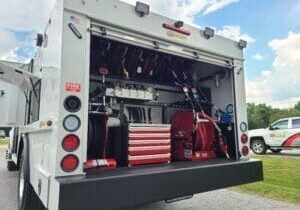
Product tanks. Each truck is set up around the oils and fluids the crew actually uses and how much of each they go through in a shift. Steel works well for oil tanks. We recommend stainless steel for DEF and antifreeze tanks because of how corrosive those fluids are.
Pumps. Air-operated pumps cost less, are popular in warmer climates, and suit small to mid-size sites. Hydraulic-driven pumps cost more, but they’re recommended for colder climates and larger or rougher sites, and they’re highly dependable over the long term.
How the LubeMaster 3417, 4417, and 5517 Fit Different Operations
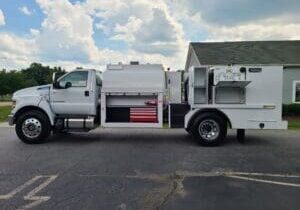
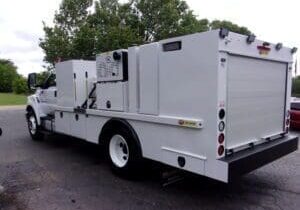
The 3417, 4417, and 5517 are our standard fuel-lube base models. Each one includes a diesel tank in its base configuration, and each can be customized with different tank capacities, layouts, and storage.
LubeMaster 3417. Built for small to medium-size fleets, the 3417 sits on a Class 6 or Class 7 chassis with a 750-gallon diesel tank, 300 gallons of new oil capacity, a 100-gallon waste oil tank, and a 50-gallon antifreeze tank. The base model doesn’t include a DEF tank.
LubeMaster 4417. Built for medium-size fleets, the 4417 is also a Class 6 or Class 7 truck. It carries a 750- or 1,000-gallon diesel tank, 340 gallons of new oil across four 85-gallon tanks, a 125-gallon waste oil tank, and 45-gallon DEF and antifreeze tanks.
LubeMaster 5517. Our largest fuel-lube base model is built for fleets with big maintenance needs. It sits on a Class 8 tandem-axle chassis with a 1,000- or 2,000-gallon diesel tank and the same product tanks as the 4417.
New oil capacity stays close across all three models, while diesel capacity and chassis class increase from the 3417 to the 5517.
The goal is a truck sized to the fuel and products the operation actually uses, on a chassis that fits the crew and the sites where it works. That starts with an understanding of how the operation handles fuel today and what the crew needs from the truck every day.
Tell us how your crew works, and we’ll help you figure out the right build.

RELATED ARTICLES
Where a Mobile Oil Change Van Earns Its Place in Your Fleet
If your technicians handle oil changes and light-duty maintenance out in the field, you know how much of their day depends on the vehicle they’re working from. A mobile oil change van gives them a compact, enclosed workspace with the oils, filters, and parts they need on board, sized for the light-duty work they do…

What Determines Whether a Fuel-Lube Truck Fits Your Operation
Fleet size, site layout, and fuel supply determine whether a fuel lube truck fits. Here’s what to consider and what we work through on the build.
Why Crews Keep Coming Back to the Same Lube Truck Builder
Why do crews keep calling the same distributor for their next lube truck? It comes down to asking the right questions before the build begins.
Building a Lube Truck Around the Job It Has to Do
A lube truck built around your job fits from day one. See how fluid mix, daily volume, job site, and chassis shape the right custom build.
Customizing Mobile Oil Change Service Trucks for Multi-Site Fleet Work
Keeping multiple job sites serviced takes coordination and the right equipment. When crews are spread out, the way your service truck is set up makes all the difference in how smoothly the day runs. A well-built mobile oil change service truck keeps maintenance consistent and crews productive. It’s not about bells and whistles, but about…
7 Things Fleet Coordinators Should Look For When Shopping for Lube Skids
When your job is to keep crews moving and equipment serviced, a lube skid can be a part of what keeps the whole operation steady. Every hose, pump, and tank plays a role in how smoothly the day runs. Whether it’s your first skid or your fifth, the same principles apply: match the build to…
Training New Crews on Your Lube Service Setup & Lube Service Body Before You Roll Out
Bringing new hands onto the crew can shift the pace. There’s a little more explaining, a few extra checks— that’s normal. The key is helping operators get comfortable with your lube setup quickly so the work keeps moving safely and efficiently. At Taylor Pump & Lift, we’ve seen how structured training keeps crews in sync…

Rebuilding a Pump (in Under 30 Seconds)
Our trucks and skids often get the majority of our limelight, but our in-house repair team is a key part of our TPL powerhouse. Working with a variety of oil pumps, meters, and reels, this team often has the tedious (but rewarding) job of diagnosing, repairing, and reassembling equipment for almost every customer in our…
What Makes a Fuel and Lube Trailer Truly Fleet-Ready? Specs That Matter
Fleet maintenance teams count on equipment that performs the same way every day. A fuel and lube trailer or lube service trailer is part of the rhythm that keeps service schedules tight, machines supplied, and crews focused on production instead of waiting on service. A trailer built for fleet work is designed with reliability at…
How to Customize a Lube Skid for Service Trucks Across Multiple Sites
If you manage a fleet that’s constantly bouncing between job sites, you know the drill: trucks waiting on fluids, machines parked mid-shift, crews wasting hours on runs back to the shop. Every delay eats into production and drives costs through the roof – and the waste adds up fast for a single truck burning about…